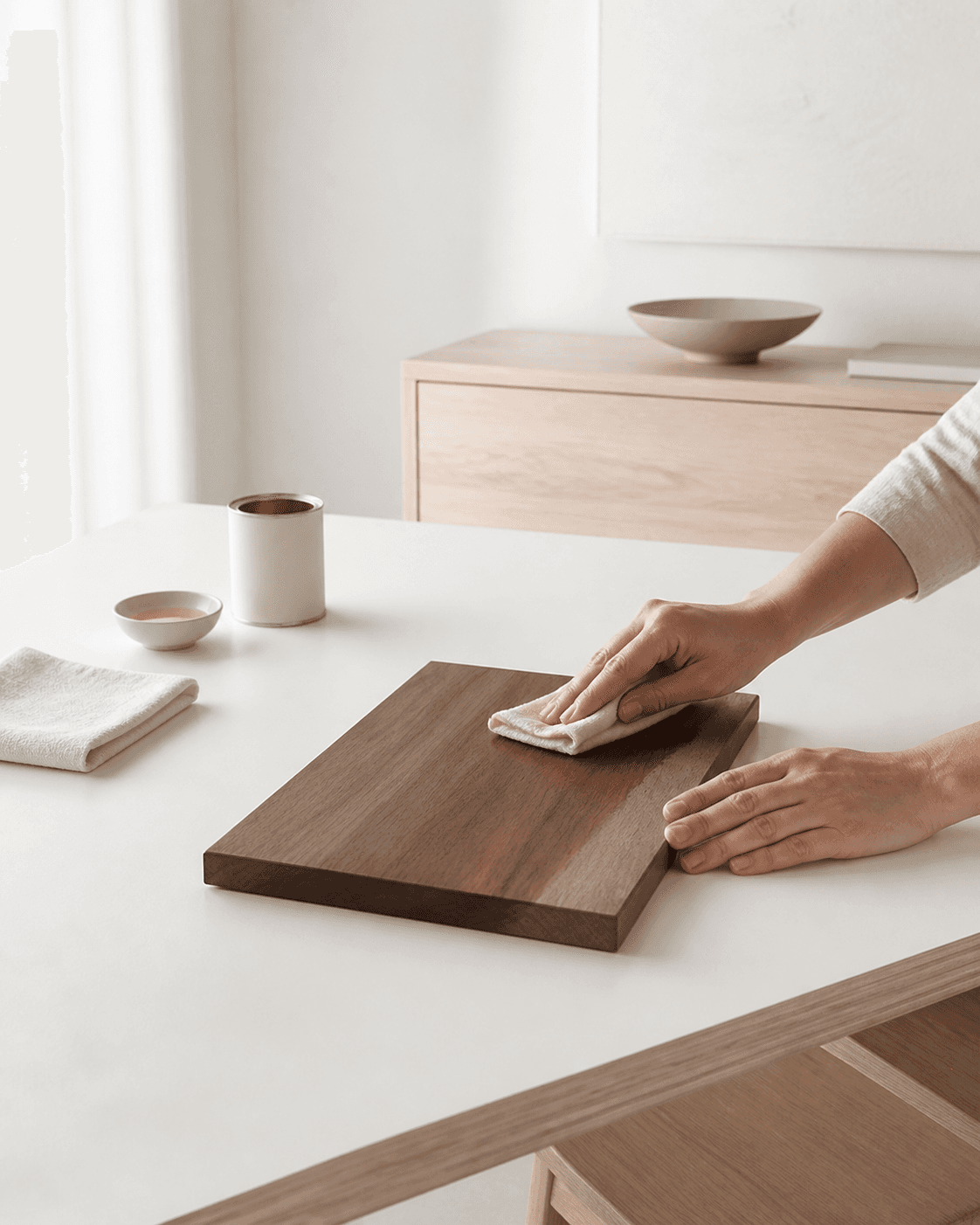
A sealed surface can resist an impressive list of laboratory tests and still be poorly suited to a long life. If a chip exposes a radically different substrate, or if a repair demands complete stripping, hardness has merely postponed a larger intervention. We favour finishes whose maintenance can be understood and whose renewal does not erase the object.
On oak and walnut, penetrating oils and hardwax systems reinforce colour while leaving the grain tactile. Small marks can often be cleaned, lightly abraded, and treated locally. The work must follow the grain and respect the surrounding sheen, but it does not require a new industrial coating line.
Metal asks a different question. A patina is a controlled beginning rather than a fixed endpoint. Wax slows change and reduces fingerprints, yet bronze and copper will still respond to touch, atmosphere, and cleaning. We provide a reference sample with significant commissions so future conservators can distinguish intended depth from accidental damage.
Glass and enamel are less forgiving of impact but straightforward to maintain when their edges are protected. Replaceable inserts, pads, and panels matter because damage rarely occurs evenly across a whole object. Designing a part to leave the piece is one of the most practical forms of longevity.
Care instructions should be specific, short, and available after installation. They are not a disclaimer. They are a continuation of the design, written for the person who will keep the object in use.
FIELD NOTE / EXCERPT
Longevity begins when maintenance is designed into the object, not added after delivery.